Wednesday, July 1, 2015

Lean In and Pseudo-Feminist Icons

In February 2015 talk show personality Jon Stewart announced his eventual exit from Comedy Central’s Daily Show. After the initial wave of pre-emptive nostalgia, the media quickly shifted its attention to who would take Stewart’s place. Online there was a groundswell in favor of one woman: Jessica Williams.

Williams was, in the eyes of many bloggers, fans, and pundits, the ideal pick. She regularly delivered some of the strongest zingers on the Daily Show. She had made repeated appearances on Lena Dunham’s hit show, Girls. Being a black woman, she was poised to contradict the white man’s domination of talk shows today.

A petition emerged on Change.org to make her the next host, which garnered over 10,000 signatures in two days.  It was beginning to seem that execs at Comedy Central would be hard-pressed to deny her the position.

Then something strange happened. Williams took to Twitter and stated outright that she did not want the position, that there were many others more qualified. The online response was to basically give her a pep talk. She just needed to believe in her abilities more.

Before taking an ongoing hiatus from Twitter, she told people to lean the fuck away from her going on to say, “I am a black woman and I am a feminist and I am so many things. I am truly honored that people love my work. But I am not yours.” 


A 2010-2013 Recap: the Rise of Sheryl Sandberg

Jessica Williams’ comment was not introducing a new concept to the public, the basic tenets of “Leaning In” were foregrounded five years ago with the work of Sheryl Sandberg. Chief-Operating Officer at Facebook, Sandberg’s networth clocks in at over a billion dollars. She graduated from Harvard College in 1991. Upon graduation she began her rise in the private sector, with a continued interest on the state of women in the workforce.

Her traction with mainstream feminist discourse can be credited by a number of things, the most obvious being her business-savvy. When we consider the list of Fortune 500 CEOs, and remember that there are more Fortune 500 CEOs with the name John than female CEOS, Sandberg’s words carry more weight. What does she have to say about the clearly pervasive patriarchy in the context of the topmost tiers of the private sector?

Before writing her 2013 bestseller, Sandberg gave a TED Talk (which garnered over 5.4 million views) followed up with a commencement address at Barnard College. Both followed the same rhetorical patterns as her book, in a more condensed form.


With the release of her book came increased public discourse around the state of women in the workplace. The gender imbalance in corporate leadership, the wage gap, and the ways women can combat these systemic inequalities. Lean In found its footing in audiences disturbed by these inequalities and looking for implementable solutions in their daily lives. Her offering was a helpful one, because it was not the practice of movement-building or a feminist revolution. Things could get a lot better if women simply kindled the will to lead and asserted themselves more.

Kiss with a Fist: Sandberg’s Pseudo-Feminism

The problem with Sandberg’s school of thought is that there’s a thread of truth in it. Women do need to be encouraged to assert themselves, to take up space. It’s when the leaning in becomes the focus of the conversation that it becomes an issue. New wave feminism or any move towards female empowerment gets twisted when it gravitates around the “you just need to speak up more.” It swerves to a dangerous place where women are held responsible for their substandard position in society. It confronts the symptom rather than the cause. Resolving the fact that women are socialized to be passive, occupy less leadership positions, it doesn’t start with a well-worded peptalk to those women already conditioned by patriarchy. It starts with breaking the system’s legs, until patriarchy cannot walk or crawl into the minds of the next generation of little girls.

And let me also say, there are many women out there, myself included, who have 99 problems and being a bitch is one.  That is to say that passivity has not been the brunt of my struggle. Resistance to assertive women, women who do not preemptively apologize, has been a problem for me. What that I cannot easily resolve by adapting my outward presentation.

Are there ways in which I reach for the nice, lady-like phrasing of an idea? Are there times when I speak less than the men in the room? Yes, and yes this is laced with the workings of patriarchy. But I, and most women in the workforce today, are not the problem. Even if we were to all eradicate the socialized tendencies towards femininity, even if we were to all to unilaterally, unconditionally lean in, would the country be ready? Would the workforce drop its preference for the tall, decisive, white man?

What’s more, by framing the discussion around leaning in, that we all just need to lean in, it quiets the women who, for centuries, have been doing just that. This isn’t to say Sandberg denies the existence of these women, it’s more that she unintentionally diminishes them. By so quickly taking the focus away from these women, past and present who are pushing hard and getting nowhere.

Interrogating the Sound Byte

There is a certain extent to which Sandberg’s popularity can also be credited to the media, to what the audience is ready for. Because when her message is boiled down to a two-sentence sound byte, or the cover of her book is mixed in with a news segment, it’s all very disarming. Her book is not titled “fuck this system, I’m getting mine” or “Surviving the Patriarchy and Tricking Men into Listening”, it’s just her smug smiling face and that strategic title. When men discuss this new wave feminist thought, it is comfortably distanced from their role in patriarchy.

The reductionist perspective on Sandberg’s book is also aligned with patriarchy. Because regardless of how much I may disagree with her school of thought, there is no getting around the fact that Lean In is a book, not devoid of truth and even some statistics. It is also not entirely patriarchy-blind. More like we put on beer goggles, looked at sexism in the workplace, and described the problem. I kid. Sort of.

And while we can look at the ways in which Sandberg’s message has been reconstructed, simplified, and manufactured, there is the obvious and important fact that she is an active participant in these appropriations. In her 2010 Ted Talk, she defined her own message, not in 240 pages of text, but in a 10 minute speech. The simplified, self-constructed message, was what the media had framed her as saying all along. The problem is that women just aren’t confident enough.

A Lesson in Movement Building

One of the more apt points made by Sandberg is regarding how the feminist movement is losing momentum. In her words “It is time for us to face the fact that our revolution has stalled.”
What she disregards, is how her work has become complicit in the pause on the movement. If we were to look at women’s position in society and say, “you know, have you tried leaning in? Just speak up more. Negotiate your contract. Ask for more”, there would be no need for a movement. The problem is the docility of women, after all.

And let’s say, this is where the toxic, sound-byte Sandberg becomes more relevant. I do not anticipate that Sheryl Sandberg genuinely believes that leaning in will resolve the broader struggle against patriarchy. But that does not detract from the fact that that is exactly what the media has been telling me. Mainstream media allowed Sandberg’s work to exist in a vacuum, one of the eminent voices in the feminist movement today. Her voice has become the microphone for a movement, a voice, that when distorted and given undue attention, essentially denies the need for a movement.  

Although some critics emerged in 2013 to explore Lean In more, we can probably start and stop with the analysis of bell hooks. While I have made many points aligned with Dr.hooks’ assessment, there is one place where our understandings of Sheryl Sandberg depart. In her article "Dig Deep," Dr.hooks states:

“Even though many advocates of feminist politics are angered by Sandberg’s message, the truth is that alone, individually she was no threat to feminist movement. Had the conservative white male dominated world of mass media and advertising not chosen to hype her image, this influential woman would not be known to most folks. It is this patriarchal male dominated re-framing of feminism, which uses the body and personal success of Sheryl Sandberg, that is most disturbing and yes threatening to the future of visionary feminist movement.” 

While the re-framing of feminist thought is certainly the most toxic, hooks' also makes a pointed rejection of Sandberg's obvious influence. Here, I believe we understate the value of allies such as Sandberg. A billionaire corporate exec who wants to be on her feminist game promoting feminist values? If the movement is to live and gain traction within the system, within our capitalist economy that disproportionately values the voice of the rich and affluent, we are missing an opportunity to radicalize Sandberg, to embrace the access to mainstream politic that she wields. We should not dismiss the potential power one widely recognized figure can offer in propelling a movement forward, and certainly not an executive that is credited with the increased profitability and popularity of the most expansive social network to date. If Sandberg's access and capital were introduced without making her a point of focus, we may be stronger for it.

Where the Angry Feminists At? New Leaders Plz.
  
There is another, even more important need in new-wave feminism that Sheryl Sandberg misses. And that’s being fucking angry. Not frustrated, not disappointed in a world that has a deficit of female leaders. But genuinely, hell-raising, movement-building, wheels spinning, all kinds of angry. The kind of emotional feminist leader that is respectability-bucking. The fire of new-wave feminism will not be kindled by soft-portraits of affluent women telling us to look inward to resolve the world’s ills.
In a 2014 panel Gloria Steinem was asked to name the biggest mistake of first-wave feminism. Her words answer Sheryl Sandberg’s statement about a stalled movement. “We were much too nice.”

As much as the basic tenets of Lean In frustrate me, it is not Sandberg we need to spend so much time discussing. It is why she has been the point of focus, why the white supremacist capitalist patriarchy presents her as a feminist vanguard when she is not. Why her message has reached as far, compared to deeper, more reflective feminist contemporaries of our time. We must not only give feminist contemporaries permission to be publicly angry and active, we must actively ask for it. We must ask for a leaders who confront not just the symptoms of patriarchy, but the causes. And when the white-male dominated media delivers an excessively palatable, watered down leader, we must be critical.

Thursday, June 18, 2015

My Last Week in Japan

My trip does not start with a train ride Saturday, June 6th. It starts about 36 hours prior. It starts with the stomach flu.
 
Mollie, how did you get stomach flu? You didn’t use your dry-heaving sister’s toothbrush right before finals did you? Again?
 
I’m going to guess I accidentally swapped drinks with a friend recovering from stomach flu. I also may have jinxed fate by telling my professor earlier in the week that I had an “iron gut.”
 
When I got back from the izakaya on Thursday night, I thought I had overdone it on the drinking. I got back at midnight and it wasn’t long before I realized what was hitting my system. I won’t get too graphic, but I was vomiting until 6 am. The kind where you need to plug your nose or unspeakable things will happen.
 
I spent the next 12 hours horizontal, wondering how I could traverse4 through Japan in a stretcher. I missed the final program banquet and missed many goodbyes. I was managing a slow re-entry into humanity by Friday evening, and met up with Veronica and Emily at their hotel’s onsen. It was a calm, enjoyable send off to Kyoto.
 
Waking up the next morning was a bit lonely. All my friends departed for the US that morning, and I had very little knowledge of where exactly I was going. I found my train okay and soon realized how successful my haphazard travel planning had been.
 
Now I should say, this past year I’ve had the fortune to spend over 80 hours on trains. Traveling through France, Italy, Hungary, South Korea. This is not a regular occurrence in my life, traveling through these breathtaking countries. Before last year I had never crossed oceans to visit anywhere. 
 
This is to say that though 80 hours sounds like a lot, the novelty hasn’t worn off yet. There’s just too much beautiful countryside, looking out a traincar window is like watching a movie.
 
So let me tell you this: when I say my trip to Matsumoto was one of the most spectacular train rides I’ve taken, you know I’m not fucking around. I became so entranced that I actually started filming the trip on my Android. It was the kind of ride where you consider just getting off at a stop with no plan, because it was too beautiful to pass by. A lot of Nagano is like that, including Matsumoto, where I stayed.
 
When I got into Matsumoto I knew two things: my hostel was far from town, and the hostel owner was coming to get me in an hour. With no phone, in a fairly large train station, I saw how my wonderful afternoon could unravel. After twenty minutes of standing outside the East exit, I also realized that if any old man approached me and told me to follow him into his car, I would do so.
Luckily the hostel owner found me okay, and drove me a short distance to where I’d be staying.
 
For all the complaining I saw online about the hostel's distance from town, it was surprisingly close, while still being positioned in between the mountains of Matsumoto near the creek bordering town.

I spent my week biking through Matsumoto, designing my photobook, and listening to plentiful podcasts. My nights were punctuated with kind visits from the hostel owner. We spoke a couple of times over shochu, talking our ways around language barriers.
 
One of my favorite days was a day trip I took to a farmers' market in the mountains. After biking uphill for what felt like forever, I stumbled upon the red-roofed market. I came across it from the wrong side, leading to me traipsing through the vineyard, creaky bike in tow. I spent a few hours looking around at the local foods, sipping coffee from the cafe overlooking everything.
 
 
However lovely my time was in Matsumoto, I did find that I was having more trouble sleeping. The night before my last day in Japan I couldn't fall asleep until the sun came up (around 7am). Even so,
I managed to rally and make a trip to a neighboring park, Kamikochi. The mountains reminded me a bit of the Grand Tetons in the US. Even though it was summer, you can tell from my video, the water was quite icy. I spent the afternoon walking around the park, listening to more podcasts, and eating cherry blossom ice cream. It was the perfect end to my adventures in Japan.

 
The trip back to Minnesota was not as eventful or beautiful as the previous six days, but it was safe. Despite having a rather solitary end to my trip, I found it to be exactly what I needed.

First Photobook

This spring I created a photobook with all of my best work from my time in Japan. This book can be found on Blurb and is quite pricey to buy in its physical form. However, you can purchase the PDF for $10.

The below image is on the cover of my book and was taken in a suburb of Tokyo.


Tuesday, June 16, 2015

What Does Liberation Look Like? Yanagi Miwa's Elevator Girls and Cross-Cultural Feminist Iconography

Among Japanese photographers today, one of the most well-known and controversial artists is Yanagi Miwa. Regarded as a feminist photographer, Yanagi’s work provokes questions around the status of women in Japan. Her work is recognized domestically and internationally, with her first photo series, Elevator Girls, receiving critical acclaim.

A crucial dynamic to note in the series’ international popularity is that of Orientalism and Western looking. The basic tenets of Orientalism define Eastern cultures broadly, in ways that are aligned with colonial power paradigms, placing the Eastern other in a position of cultural inferiority to the West. The art world is not divorced from Orientalist perspectives, just the opposite. The international art world is criticized for seeking out Japanese art that reinforces Western preconceived notions of Japanese aesthetic (leaving little room for modern Japanese artists to thrive). Miwa Yanagi’s global popularity, therefore, must also be considered critically, for it is very often that Asian artists find international accolades only through supporting Western expectations of Eastern art.

In her art and design thesis, Rachel Chamberlain notes that Elevator Girls is criticized by some for being self-orientalizing.[1] Here the concerns around Western looking are two-fold; first, there is the concern around Western art critics disproportionately valuing Asian artwork that criticizes an Asian society, artwork that reinforces the perceived cultural and sociopolitical inferiority of the Orient. This concern applies to readings of the Elevator Girls as a critique of gender roles in Japanese society. The second concern is around the iconography of Yanagi’s landscapes in Elevator Girls. She creates futuristic landscapes with bright lights and a strong sense of technological development. An example is one of Yanagi’s photographs in which elevator girls are in a glass display case under bright lights. 

 
Techno-orientalism fetishizes technological development in the East, continuing Western objectification of Eastern cultures. Iconography that resonates with bubbling, (often) subconscious techno-orientalist readings become more apparent in some critics referring to the elevator girls as appearing "robotic", looking more "cyborg" than human.

I will not belabor this point any further, but do wish to contextualize Yanagi’s work in an art world and global audience that remains entangled in Eastern othering. With so many interpreting Yanagi’s work as being laced with sociopolitical critique, we must observe these interpretations as not existing in a vacuum. Yanagi’s artistic aesthetic, and international audiences’ responses to her work, are never entirely divorced from the Western Gaze.

Feminist Iconography

Interrogating what creates images of female disempowerment or liberation is central to reading Elevator Girls. Western readings often find the photo subjects’ homogeneity as a negative illustration, one that proves they are unable to exercise agency through expressing themselves individually. This argument comes into conflict with the common idea in feminist theory, that narrow expectations and expressions of femininity are inherently oppressive. Conforming to societal standards of femininity is, often in the United States, viewed as a symptom of societal pressure that reduces control over self-representation. In this way we must recognize that if you subscribe to such views of femininity, you are predisposed to view Yanagi’s depiction of femininity as a critique of societal pressure. Whether we should regard subscription to narrow standards of femininity as devoid of agency is a complicated question. Although there is not time enough to explore this question deeper, we must recognize that in reading Yanagi’s images we quickly approach a fork in the road. One in which we are asked to read the elevator girls as exercising or being denied agency, in the context of conventional expressions of femininity.

If we broaden our understanding of female agency some of the feminist readings of Elevator Girls weakens. Another complication is the historical background on the elevator girl position in Japan, one of the first jobs that offered single University graduates the opportunity to support themselves. Although the elevator girl profession demanded that young women showcase their beauty and “guide” shoppers at different places in department stores, it also inadvertently exhibited young Japanese women supporting themselves in a developing Japanese economy. A job that demanded women subject themselves to, and profit from the gaze, became a visible mode by which young women gained socioeconomic independence (Chamberlain 2010).
 
And yet, even with this broader understanding of female agency, there are those images within Yanagi’s series that, I would argue, are palpably negative. The most obvious example of this being the image of four women on the ground, shot from the ceiling. The images show a progression of the elevator girls, wearing red, dissolving into a pool of blood. The elevator girls in Yanagi’s series are frequently captured lying on the ground, appearing lifeless.


Discerning those instances where we assume a woman has no agency, versus discovering it through visual cues, is challenging. While Yanagi’s series certainly finds its footing in some degree of sociopolitical critique, its most interesting offering may not speak to gender dynamics in Japan, so much as cross-cultural formations of feminist thought. Through looking at the Elevator Girls, viewers are encouraged to reflect on the parameters of feminist images and depictions of female liberation. The questions introduced in a bell hooks panel on representations of women may best summarize the questions Yanagi provokes:  “… who actually has ownership? Who is making the decisions and is it more powerful for us to make those decisions and put our body on display, or not? Was it more powerful for us to be shamed into thinking our bodies shouldn’t be displayed, or not? Are we free because we are displaying? Are we free because of who we are displaying for? What liberates us in the process” (New School panel 2014)?
 

[1] Definitions of self-orientalism are often coupled with rising concerns around techno-orientalism. “Those perceived cultural traits are turned into cultural assets, and merchandised as such. What the techno-orientalist deformative lens perceives as robotic, gregarious, and self-emasculated way of life is presented as a considerate, balanced and reliable behavior. Paradoxically, the culture, tourism and entertainment insures from Japan have been exporting products that undergo symbolic negotiation in Western markets and, all too often, become techno-orientalist avatars” (Lozano-Mendez 186, 2010).

Listen to For Colored Nerds Now

I have a question for my fellow white folk reading this mag: how does it feel to engage with media that is almost exclusively created for you? TV shows, movies, music, so much of it emphasizes whiteness and fails to represent people equitably. Since I was a child, I’ve been inundated with white voices. In the media, in the coursework I am assigned, who I hear on the radio. And irony of ironies, I stumbled across this podcast after listening and loving Serial, a show that follows a white woman decoding how a likely innocent Muslim boy was sentenced to life in prison for murder.
 
 
The title of this podcast references Nitozake Shange’s work, For Colored Girls Who Have Considered Suicide, but also highlights who the podcast is for. For Colored Nerds is not made for me or any white person really. And that is what drew me to the podcast to begin with. Because it’s just as important to listen to what wasn’t made for you as listening to the stuff that was.
 

It also must be said, FCN is not intended to decenter whiteness, that’s more of an added benefit. Listening the podcast you’ll soon see…it’s just a fun podcast. Brittany and Eric deliver a new episode every other week, tackling whatever entertainment topic is trending at the time. And if you get around to listening to them, you’ll probably enjoy the way they communicate, the world they’re sharing. If This American Life is a couple of journalists sitting stiffly in a studio, gravelly voice and forced formality, FCN is two of your closest and smartest friends, sitting on a couch, bantering and back-talking (with no small amount of academic metal-wielding). 
 

Favorite Episodes
Blacker the Violence
The Price of Black Ambition
The Smudging Part I

Saturday, June 6, 2015

Bike Trip to Asuka (Day 2)

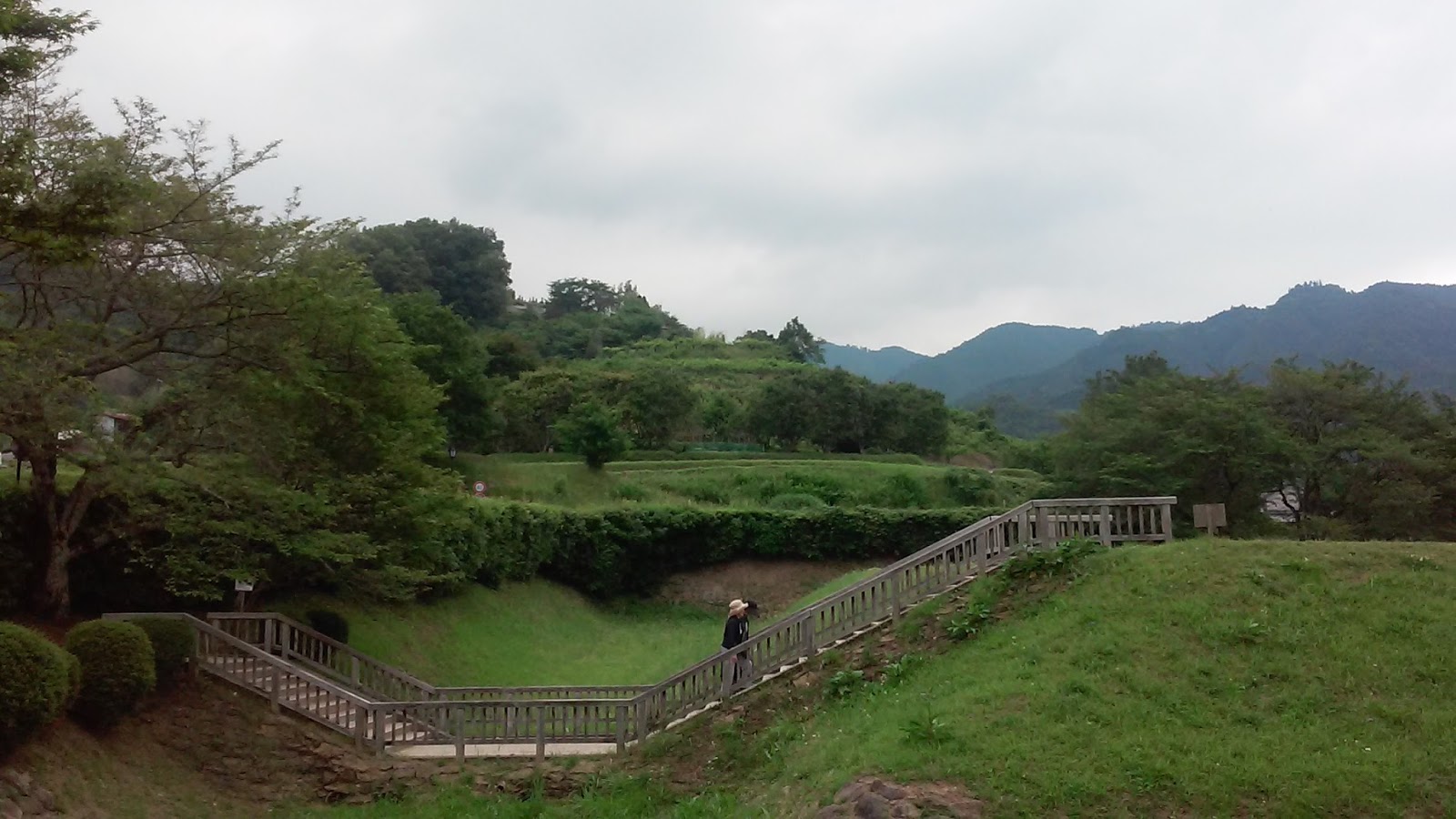
Sunday morning at 7am we were up and packing. Breakfast was a traditional, savory Japanese meal with fish, rice, vinegar and egg. After breakfast we had established a pattern of Tetsuya neatly and quietly finishing his meal long before the rest of the group. Even with my haphazard approach to fine dining, we were done and out of the hotel at 8:30 am. To illustrate a regular morning in Asuka, here are pictures from our hotel:


For the next couple hours we toured around Asuka. We visited a stone tomb, a museum, and Japan's oldest Buddhist temple.

By the time we visited the temple I was wishing for more time to take in my surroundings. I toured around the temple briefly, then snuck outside where there were beautiful views and a little convenience store. This is how I came to eating vanilla ice cream outside Japan's oldest temple at 10:30 am.

Outside the tomb
Once we finished at the temple we left for Nara. The morning in Asuka was cloudy in a way we all appreciated. Heading for Nara, the sun came out, but temperatures stayed at a safe 75 with wind and occasional clouds. To all of our surprise we were moving much faster than the day before, a probably of result of the dramatic change in weather conditions.

For lunch we stopped into a grocery store. It was small with wood floors, natural lighting, and almost exclusively local, fresh produce. We had found the birkenstock, clove-smoking, hipster vegetarian's paradise. It was all affordable and we ended up buying a cake to share.

Lunch was the final installment of Tetsuya finishing before I'd even started. The sushi was delicious, as was the cake, which Koji managed to cut into pieces WITH CHOPSTICKS.

Koji aka Cake Tsar/Lord of the Roads
The rest of our trip back was smooth and comfortable. At the end of the day we stopped for some bubble tea and shaved ice. Bodies sore and slightly sunburned, we biked 55 miles in two days. The trips was one of, if not the, best moments while abroad in Japan. I'm so grateful to Koji, Tetsuya, Anne, Emily, and Veronica, for making it so special.